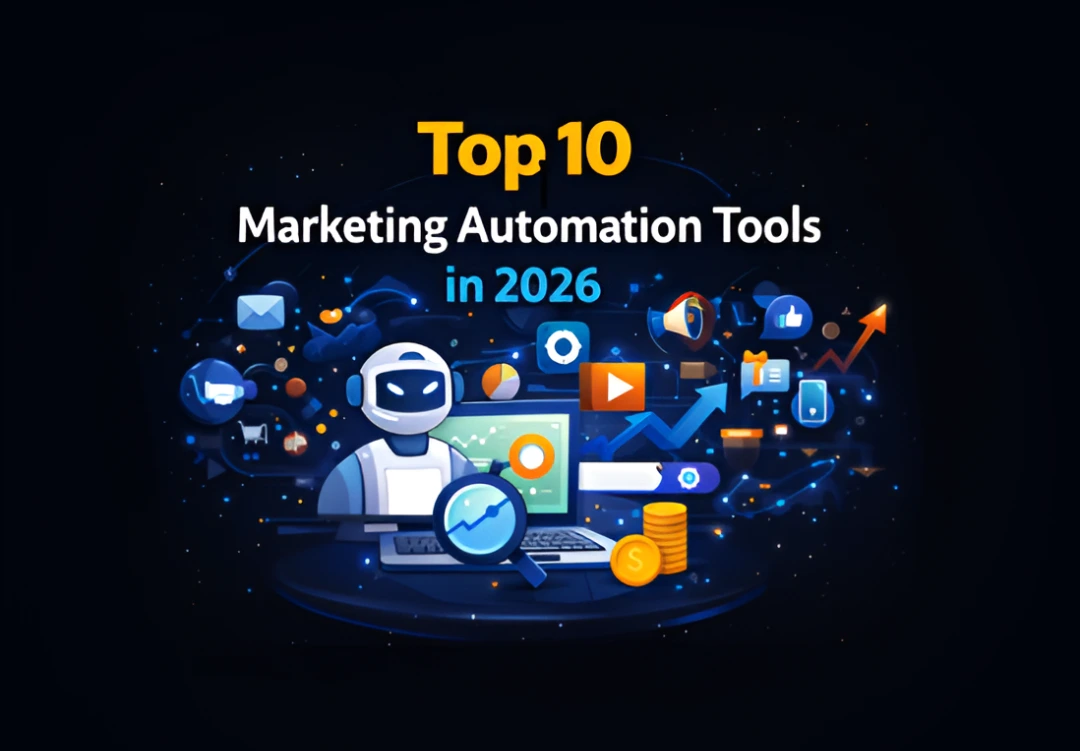
Marketing automation tools are platforms that send the right message to the right customer automatically, based on their behaviour and data. This guide compares the top 10 marketing automation tools for 2026, from all-in-one suites to eCommerce and app-first platforms, and explains how to choose the right one for your team.
The 10 best marketing automation tools in 2026 at a glance:
- HubSpot Marketing Hub: best all-in-one platform for inbound and B2B
- Adobe Marketo Engage: best for enterprise B2B
- Salesforce Marketing Cloud: best for data-driven omnichannel marketing
- ActiveCampaign: best for SMBs and growing startups
- Klaviyo: best for ecommerce
- Mailchimp: best for beginners
- Salesforce Marketing Cloud Account Engagement (Pardot): best for B2B teams on Salesforce
- MoEngage: best for mobile-first and app brands
- Brevo: best budget option for email and SMS
- Bloomreach Engagement: best for ecommerce personalisation
Last updated: October 8, 2026
Introduction
Marketing automation is no longer a luxury – it’s the backbone of scalable, data-driven growth. As we move deeper into AI-first ecosystems, businesses that rely on manual workflows are falling behind. In this guide, we’ll explore the Top 10 Marketing Automation Tools in 2026 that every marketer, founder, and growth leader should know.
These tools are shaping the future of customer journeys, personalization, lead nurturing, and performance optimization.
Quick comparison: top marketing automation tools in 2026
| Tool | Best for | Key channels | Pricing model |
|---|---|---|---|
| HubSpot Marketing Hub | All-in-one inbound marketing automation | Email, SMS, WhatsApp, social, ads, landing pages, live chat | Free plan; paid tiers priced by seats and marketing contacts |
| Adobe Marketo Engage | Enterprise-level automation | Email, web, mobile, social, paid media, events and webinars, chat | Custom quote (packages via sales) |
| Salesforce Marketing Cloud | Data-driven omnichannel marketing | Email, SMS, mobile push, WhatsApp, web | Editions billed annually; contact sales |
| ActiveCampaign | SMBs and growing startups | Email, SMS (add-on), WhatsApp, landing pages, site messages | Paid tiers priced by contacts; free trial |
| Klaviyo | eCommerce marketing automation | Email, SMS, WhatsApp, push, web | Free plan; paid plans priced by active profiles |
| Mailchimp | Beginners and content creators | Email, SMS (add-on, select countries), landing pages, social posts and ads | Free plan; paid tiers priced by contacts |
| Salesforce Account Engagement (Pardot) | B2B automation | Email, landing pages, forms (SMS and WhatsApp as add-ons) | Editions billed annually; contact sales |
| MoEngage | Mobile-first and app-based marketing | Push, in-app, email, SMS, WhatsApp, on-site messaging | Custom quote (contact sales) |
| Brevo | Cost-effective automation | Email, SMS, WhatsApp, web and mobile push, live chat | Free plan; paid tiers priced by monthly email volume |
| Bloomreach Engagement | Ecommerce and consumer brands that need real-time personalisation | Email, SMS, mobile push, in-app, WhatsApp, web personalisation | Custom quote |
Pricing models and channels checked on each vendor’s official website in September 2026. Plans change often, so confirm current details on the vendor’s pricing page.
Why Marketing Automation Matters More Than Ever in 2026
In 2026, marketing automation goes far beyond scheduling emails or triggering workflows. Today’s tools integrate AI, predictive analytics, omnichannel engagement, and real-time personalization to deliver measurable ROI.
Key benefits include:
- Faster lead conversions
- Hyper-personalized customer experiences
- Reduced manual workload
- Smarter data-driven decisions
- Improved customer lifetime value (CLV)
Now let’s dive into the Top 10 Marketing Automation Tools in 2026.
1. HubSpot Marketing Hub
What it is: HubSpot continues to dominate the marketing automation landscape in 2026. Its AI-powered CRM, smart workflows, and content automation make it ideal for businesses of all sizes.
Best for: All-in-one inbound marketing automation
Key features:
- AI-driven lead scoring
- Email, CRM, and content automation
- Advanced analytics dashboards
- Seamless integrations
Pros:
- CRM, marketing and content tools in one platform
- Free plan to get started
- Large integration ecosystem
Cons:
- Costs rise as seats and marketing contacts grow
- Advanced automation is limited to higher tiers
2. Marketo Engage (Adobe)
What it is: Marketo remains a strong contender among the Top 10 Marketing Automation Tools in 2026, especially for large organizations managing complex buyer journeys.
Best for: Enterprise-level automation
Key features:
- Advanced lead nurturing
- Account-based marketing (ABM)
- AI personalization via Adobe Sensei
- Enterprise-grade analytics
Pros:
- Deep lead nurturing and ABM for complex B2B journeys
- Fits well with the wider Adobe ecosystem
Cons:
- Steep learning curve; usually needs a dedicated admin
- Pricing is by custom quote only
3. Salesforce Marketing Cloud
What it is: Built for scale, Salesforce Marketing Cloud excels at handling customer data and automating personalized experiences across channels.
Best for: Data-driven omnichannel marketing
Key features:
- Customer journey orchestration
- Predictive analytics
- Email, SMS, push, and social automation
- Deep CRM integration
Pros:
- Handles large data volumes and complex omnichannel journeys
- Native integration with Salesforce CRM
Cons:
- Complex implementation that typically needs specialists
- Enterprise pricing through sales
4. ActiveCampaign
What it is: ActiveCampaign strikes a balance between power and affordability, making it a top choice in the Top 10 Marketing Automation Tools in 2026 for small and mid-sized businesses.
Best for: SMBs and growing startups
Key features:
- Visual automation builder
- Advanced email segmentation
- AI-based predictive sending
- CRM + automation in one platform
Pros:
- Visual automation builder that’s easy to learn
- CRM and automation in one platform
Cons:
- SMS and WhatsApp are paid add-ons
- No free plan, only a free trial
5. Klaviyo
What it is: Klaviyo has become essential for DTC and eCommerce brands in 2026 due to its deep data integrations and revenue-focused automation.
Best for: eCommerce marketing automation
Key features:
- Behavior-based email & SMS flows
- Real-time customer data syncing
- AI-powered recommendations
- Shopify & WooCommerce integration
Pros:
- Deep eCommerce integrations such as Shopify and WooCommerce
- Revenue-focused reporting
Cons:
- Built for eCommerce, less suited to B2B lead management
- Costs scale with active profiles
6. Mailchimp (AI-Enhanced)
What it is: Mailchimp has evolved far beyond basic email marketing. In 2026, its AI tools make automation simple yet powerful.
Best for: Beginners and content creators
Key features:
- Smart email automation
- AI content suggestions
- Audience segmentation
- Marketing analytics
Pros:
- Easy to start, with a free plan and ready-made templates
- Good for newsletters and simple automation
Cons:
- Automation is less advanced than dedicated platforms
- SMS is a paid add-on available only in select countries
7. Pardot (Marketing Cloud Account Engagement)
What it is: Pardot is a top B2B choice among the Top 10 Marketing Automation Tools in 2026, especially for long sales cycles.
Best for: B2B automation
Key features:
- B2B lead nurturing
- Salesforce CRM sync
- ROI tracking
- Account-based marketing tools
Pros:
- Built for B2B lead nurturing, with native Salesforce CRM sync
- ABM and ROI reporting
Cons:
- Best value only if you already use Salesforce CRM
- Annual contracts through sales
8. MoEngage
What it is: MoEngage is gaining massive traction in 2026 for brands focusing on mobile engagement and lifecycle automation.
Best for: Mobile-first & app-based marketing
Key features:
- Cross-channel automation
- AI segmentation
- Push notifications & in-app messaging
- Customer journey analytics
Pros:
- Strong push and in-app messaging for app-first brands
- AI segmentation and journey analytics
Cons:
- Less focused on B2B lead management
- Pricing is by custom quote
9. Brevo (Formerly Sendinblue)
What it is: Brevo offers robust automation at a competitive price, earning its place among the Top 10 Marketing Automation Tools in 2026.
Best for: Cost-effective automation
Key features:
- Email & SMS automation
- Marketing workflows
- CRM capabilities
- Real-time analytics
Pros:
- Free plan and affordable paid tiers
- Email, SMS and WhatsApp in one place
Cons:
- WhatsApp and push are only on higher tiers
- Less depth than enterprise platforms
10. Bloomreach Engagement
What it is: Bloomreach Engagement is a customer data and marketing automation platform that combines customer profiles, segmentation and real-time personalisation across channels.
Best for: Ecommerce and consumer brands with large customer bases
Key features:
- Real-time customer profiles and segmentation
- Scenario-based journeys across email, SMS, push, in-app and WhatsApp
- Website personalisation and recommendations
- A/B testing and campaign analytics
Pros:
- Customer data and automation in one platform
- Strong personalisation for ecommerce
Cons:
- Needs proper data modelling and event tracking to get full value
- Pricing is by custom quote
Marketing automation tools popular in India
Several of the customer engagement platforms most used by Indian consumer brands were founded in India:
- MoEngage: app-first engagement across push, in-app, email, SMS and WhatsApp.
- CleverTap: mobile app engagement and retention, with segmentation and journeys.
- WebEngage: customer data and journeys across channels for consumer brands.
- Netcore Cloud: email, app engagement and personalisation.
For B2B teams, HubSpot and Zoho are common choices. Zoho suits teams already on Zoho CRM; our Zoho CRM implementation guide covers how to set it up. Comparing the app platforms? Read MoEngage vs CleverTap vs WebEngage.
How to choose a marketing automation tool
When selecting from the Top 10 Marketing Automation Tools in 2026, consider:
Your main channels
List the channels you need now and over the next year: email, SMS, push, WhatsApp or in-app. Email-first tools like Mailchimp and ActiveCampaign suit newsletters and nurture programs, while app-first brands usually need push and in-app messaging from a platform like MoEngage.
Your data setup and integrations
Automation only works when the tool sees accurate customer data. Check native integrations with your CRM, website and app, how events and profiles sync, and whether you’ll need a connector like Zapier or custom development to fill the gaps.
B2B or consumer and app use case
B2B teams need lead scoring, lifecycle stages and CRM sync with sales, which HubSpot, Marketo and Account Engagement are built for. Consumer and app brands need real-time behavioural triggers and high-volume messaging, where Klaviyo, MoEngage and Salesforce Marketing Cloud are stronger.
Team skills and setup effort
Enterprise platforms like Marketo and Salesforce Marketing Cloud are powerful but usually need specialists to implement and run. Tools like Mailchimp, Brevo and ActiveCampaign can be set up and managed by a small marketing team.
Total cost as you grow
Pricing is usually tied to contacts, active profiles, messages sent, seats or tasks, and some channels are paid add-ons. Estimate what you’d pay at two or three times your current audience, and include implementation and onboarding costs.
AI and analytics capabilities
Look for predictive scoring, send-time optimization and reporting that ties campaigns to revenue, not just opens and clicks.
Comparing app engagement platforms specifically? Read MoEngage vs CleverTap vs WebEngage.
Conclusion
Marketing automation in 2026 is about intelligence, personalization, and efficiency. The tools listed above represent the most powerful platforms shaping modern marketing strategies.
Choosing the right solution from the Top 10 Marketing Automation Tools in 2026 can help you automate smarter, convert faster, and scale sustainably. If you need help setting a platform up or connecting it to your CRM and data, our MarTech automation services cover implementation, migration and journey building.
Related reading: how we implement these platforms in our MarTech automation services, and how to use them to keep users with our customer retention strategies for consumer apps. Choosing between engagement platforms? See WebEngage vs CleverTap.
Frequently asked questions
Marketing automation tools are platforms that send messages and run campaigns automatically based on customer behaviour and data. They handle tasks like email and SMS journeys, lead scoring, segmentation and reporting, so teams can reach the right person at the right time without manual work.
It depends on your use case. HubSpot suits all-in-one inbound marketing, Klaviyo suits eCommerce, MoEngage suits app-first brands, and Marketo or Account Engagement suit complex B2B journeys. The comparison table above shows which tool fits which need.
Inbound marketing tools help you attract visitors with content, SEO, social media and landing pages. Marketing automation tools act on the leads and customers you already have, sending triggered messages and nurturing them based on their behaviour. Some platforms, like HubSpot, combine both.
ActiveCampaign, Brevo and Mailchimp are popular with small businesses because they’re quick to set up and offer free plans or free trials. Mailchimp suits simple email programs, Brevo adds SMS and WhatsApp on a budget, and ActiveCampaign offers more advanced automation with a built-in CRM.
Most tools price by the number of contacts or active profiles, by emails or messages sent, by user seats, or by custom quote for enterprise platforms. Many offer a free plan or free trial, and channels like SMS and WhatsApp are often paid add-ons or credits. Check each vendor’s pricing page for current rates.
AI enables predictive analytics, personalization, lead scoring, and smarter campaign optimization.
No. Automation enhances efficiency, but strategy, creativity, and decision-making still require human expertise.
Klaviyo is the top choice for eCommerce automation in 2026.
MoEngage, CleverTap, WebEngage and Netcore Cloud are widely used by Indian consumer and app brands, and were all founded in India. For B2B teams, HubSpot and Zoho are common choices.
Need help setting up or migrating a marketing automation platform? MindMark implements Bloomreach Engagement, HubSpot, MoEngage, CleverTap, WebEngage and Zoho.

Leave a Reply