
Introduction
Startups in 2026 are not failing because of bad ideas – they are failing because of poor distribution, unclear positioning, weak data tracking, and inconsistent execution.
The digital ecosystem is more competitive than ever. Customer acquisition costs are rising, privacy regulations are tightening, and AI-driven personalization is becoming standard. In this environment, growth cannot be random. It must be structured.
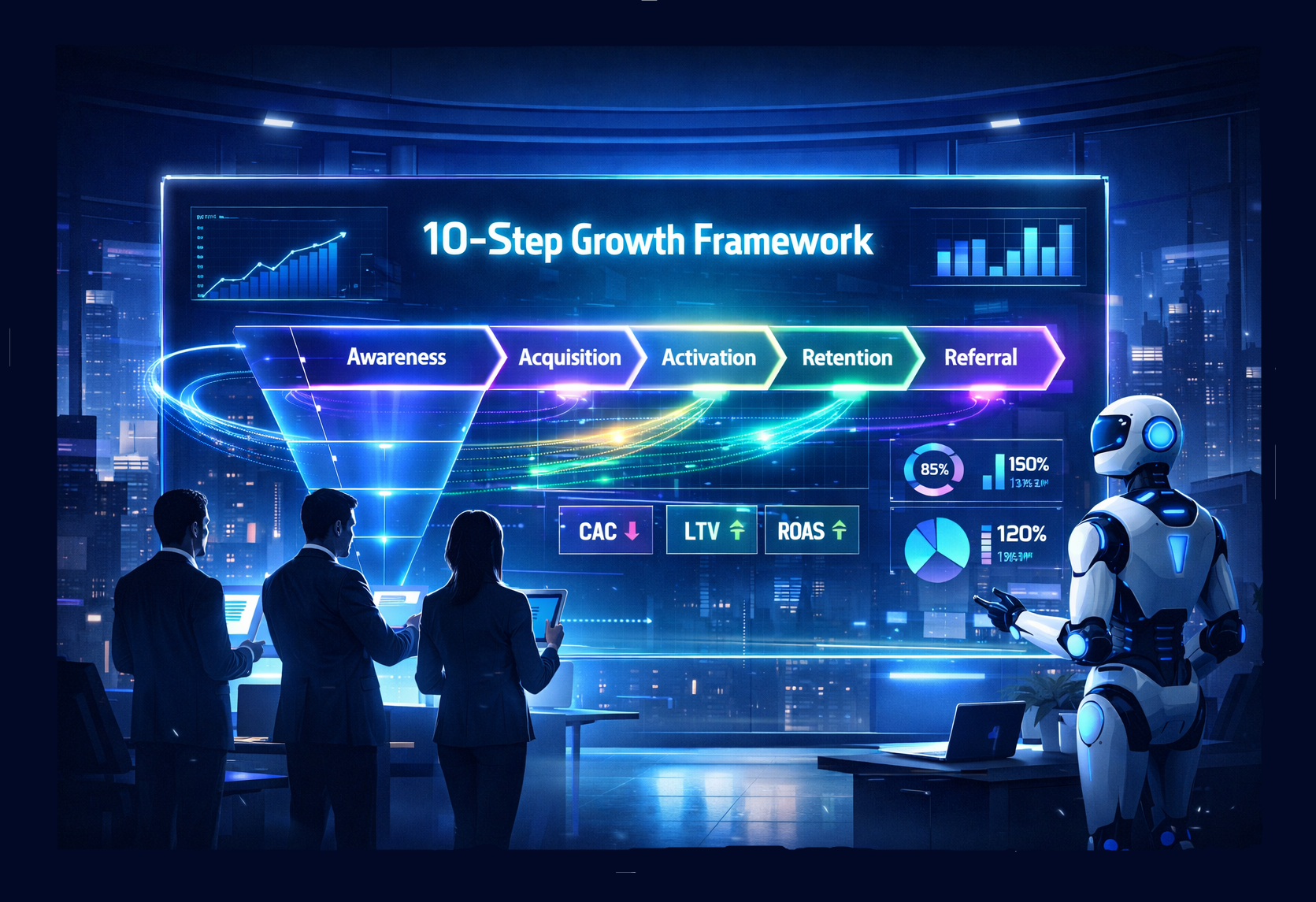
This is where a 10-step growth marketing framework becomes essential.
Unlike traditional marketing, growth marketing focuses on the entire customer journey – from acquisition to retention to referral – using data, experimentation, automation, and continuous optimization.
Let’s break down the exact framework every startup should follow in 2026.
Step 1: Define Your Ideal Customer Profile (ICP)
Before running ads or creating content, you must clearly define:
- Who is your perfect customer?
- What problem are they actively trying to solve?
- What triggers them to look for a solution?
- Where do they spend time online?
Avoid targeting “everyone.” Specificity increases conversion rates.
In 2026, AI-powered personalization makes hyper-targeting possible – but only if you deeply understand your audience.
Create:
- 1–3 detailed buyer personas
- Pain points
- Objections
- Buying triggers
- Budget level
- Decision-making process
Without this clarity, growth efforts waste money.
Step 2: Craft a Clear & Compelling Value Proposition
Your value proposition should answer:
Why should someone choose you over competitors?
It must be:
- Outcome-focused
- Specific
- Differentiated
- Easy to understand in 5 seconds
Instead of saying:
“We provide marketing solutions.”
Say:
“We help SaaS startups increase qualified leads by 40% in 90 days using data-driven growth systems.”
Clarity builds trust. Specificity builds conversions.
Step 3: Build a High-Converting Website & Funnel
Your website is not a brochure. It’s a conversion machine.
Key elements:
- Strong headline
- Clear problem-solution messaging
- Social proof (testimonials, case studies)
- Clear CTA (Book a Call, Start Free Trial, Get Demo)
- Fast loading speed
- Mobile optimization
In 2026, startups must also optimize for:
- AI search experiences
- Conversational interfaces
- Interactive landing pages
- Personalized CTAs
Your funnel should guide users logically:
Awareness → Interest → Consideration → Conversion → Retention
Step 4: Set Up Advanced Tracking & Analytics
You cannot grow what you cannot measure.
Before scaling traffic, set up:
- Conversion tracking
- Funnel tracking
- Event tracking
- Attribution models
- Heatmaps
- A/B testing tools
Track metrics like:
- CAC (Customer Acquisition Cost)
- LTV (Lifetime Value)
- ROAS
- Conversion rate
- Churn rate
Data removes guesswork. Decisions must be data-backed, not emotional.
Step 5: Develop a Multi-Channel Acquisition Strategy
Relying on one channel is risky.
Your acquisition mix in 2026 should include:
- SEO & content marketing
- Paid advertising (Google, Meta, LinkedIn)
- Short-form video platforms
- Email marketing
- Partnerships & collaborations
- Community marketing
Startups should test 2–3 channels first. Double down on what works.
Focus on:
- Low CAC channels
- High intent traffic
- Scalable platforms
The goal is sustainable acquisition – not temporary spikes.
Step 6: Implement Rapid Experimentation (Growth Sprints)
Growth in 2026 belongs to teams that test fast.
Follow this cycle:
- Hypothesis
- Test
- Measure
- Learn
- Optimize
Run experiments on:
- Ad creatives
- Headlines
- Landing pages
- Pricing
- Email sequences
- Offers
Every month, run at least 5–10 experiments.
Small improvements compound.
A 10% improvement in:
- CTR
- Conversion rate
- Retention
… can dramatically increase revenue over time.
Step 7: Optimize the Activation Experience
Acquisition is expensive. Activation is critical.
Activation means the user experiences your core value quickly.
For example:
- SaaS → user completes first workflow
- E-commerce → user makes first purchase
- Service → user books consultation
Reduce friction:
- Simplify onboarding
- Use guided tutorials
- Add product walkthrough videos
- Provide instant value
The faster users experience value, the higher the retention.
Step 8: Focus on Retention & Customer Lifetime Value (LTV)
In 2026, retention is the real growth engine.
Acquiring new customers is more expensive than keeping existing ones.
Improve retention through:
- Email nurturing
- Loyalty programs
- Upsells & cross-sells
- Community building
- Regular product improvements
Track:
- Churn rate
- Repeat purchase rate
- Customer satisfaction
A startup with high retention can outgrow competitors even with lower ad spend.
Step 9: Build Referral & Advocacy Systems
Happy customers are your best marketers.
Create structured referral systems:
- Incentivized referrals
- Affiliate programs
- User-generated content campaigns
- Testimonial requests
- Case studies
Social proof builds trust faster than ads.
Encourage:
- Reviews
- Video testimonials
- LinkedIn recommendations
- Community shoutouts
Organic advocacy reduces CAC significantly.
Step 10: Scale What Works (Not What’s Trendy)
Once you find profitable channels:
Scale intelligently.
Increase:
- Budget on high ROAS campaigns
- Content production for ranking topics
- Automation systems
- Team capacity
Avoid chasing trends without validation.
Scale based on:
- Data
- Unit economics
- Predictable ROI
Sustainable growth is repeatable growth.
Conclusion
The startups that scale in 2026 won’t be the ones spending the most on ads.
They’ll be the ones:
- Tracking the right data
- Testing consistently
- Optimizing the full funnel
- Increasing LTV
- Building brand trust
Growth is not magic.
It’s structured execution.
If you implement this 10-step framework properly, your startup won’t just grow – it will scale predictably.
Frequently Asked Questions
What is a growth marketing framework?
A growth marketing framework is a structured, data-driven approach that focuses on the entire customer journey – from acquisition and activation to retention and referrals. Unlike traditional marketing, it emphasizes continuous testing, optimization, and long-term customer value rather than just lead generation.
How is growth marketing different from traditional marketing?
Traditional marketing mainly focuses on brand awareness and top-of-funnel activities. Growth marketing, on the other hand, optimizes every stage of the funnel using experimentation, analytics, automation, and performance tracking to maximize ROI and scalability.
How long does it take to see results from a growth marketing strategy?
Most startups start seeing measurable improvements within 60–90 days if proper tracking and experimentation systems are in place. However, sustainable and scalable growth typically requires 3–6 months of consistent optimization and testing.
What metrics should startups track in 2026 for growth?
Key metrics include:
- Customer Acquisition Cost (CAC)
- Lifetime Value (LTV)
- Conversion Rate
- Retention Rate
- Churn Rate
- Return on Ad Spend (ROAS)
Tracking these metrics ensures startups make data-driven decisions instead of guessing.
Can early-stage startups implement this 10-step growth framework with a small budget?
Yes. Early-stage startups can start lean by focusing on 1–2 acquisition channels, using free or affordable analytics tools, and running small experiments. Growth marketing is about smart execution and optimization – not just large budgets.
Leave a Reply