
INTRODUCTION
Search is no longer just about rankings – it’s about visibility inside AI answers.
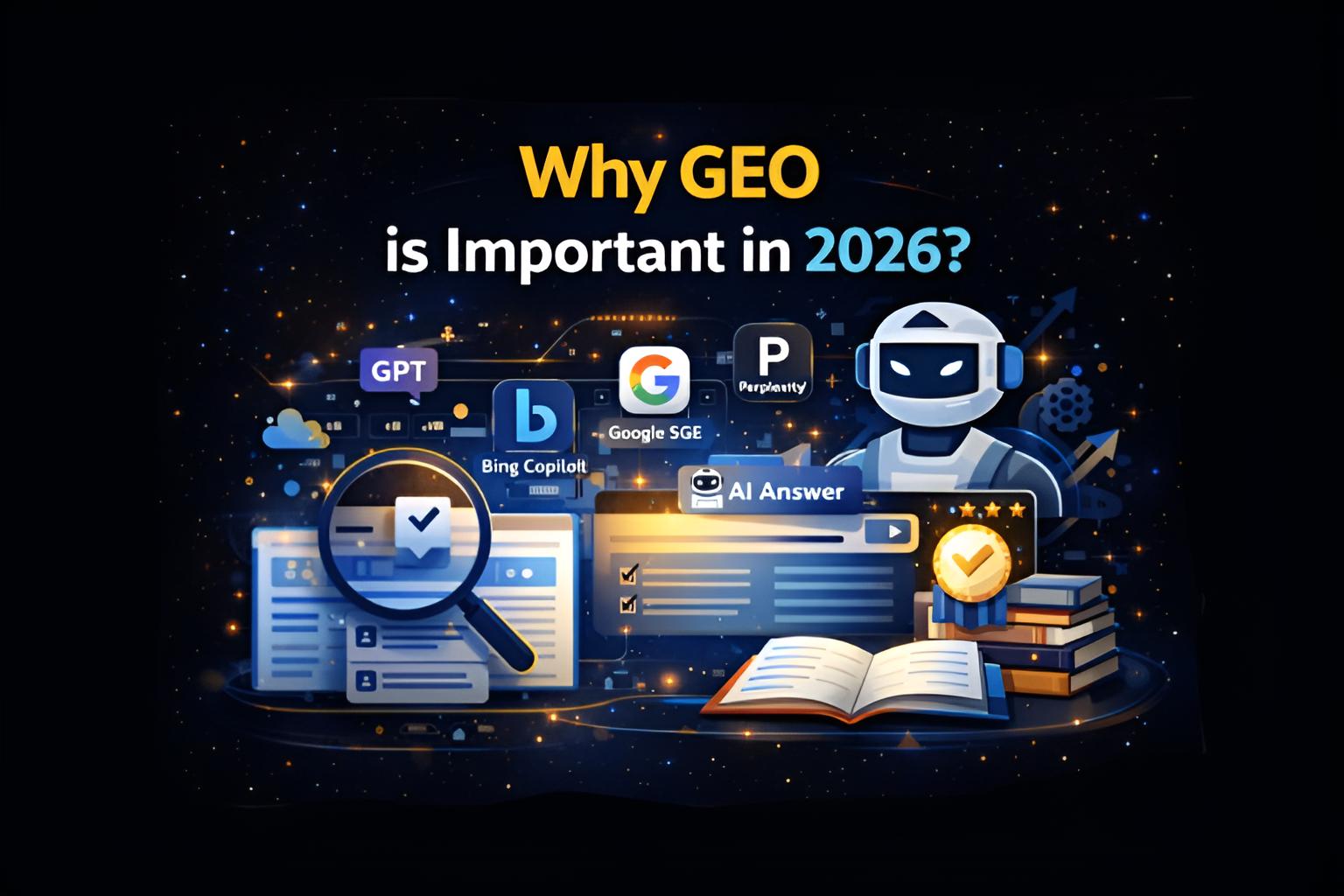
As AI-powered search engines like Google SGE, ChatGPT, Perplexity, and Bing Copilot reshape how users discover information, Generative Engine Optimization (GEO) has emerged as a critical digital marketing discipline. In 2026, businesses that ignore GEO risk becoming invisible – no matter how strong their traditional SEO is.
This blog explains why GEO is important in 2026, how it differs from SEO, and how brands can future-proof their digital presence.
What Is GEO (Generative Engine Optimization)?
Generative Engine Optimization (GEO) is the process of optimizing content so it is understood, selected, and cited by AI-driven search engines and large language models (LLMs).
Unlike traditional SEO, which focuses on ranking webpages, GEO focuses on:
- Being referenced in AI-generated answers
- Appearing in zero-click AI responses
- Structuring content for machine comprehension
In short, GEO ensures your content is not just indexed – but used.
Why GEO Is Important in 2026?
1. AI Search Is Replacing Traditional Search Behavior
In 2026, users are increasingly asking:
- “Explain…”
- “Compare…”
- “Summarize…”
- “Best tools for…”
AI search engines provide direct answers, often without showing blue links. If your content isn’t optimized for GEO, it won’t appear at all – even if it ranks on page one.
2. Zero-Click Searches Are Dominating
Google and AI assistants now answer questions directly in:
- AI Overviews
- Chat interfaces
- Voice search results
This makes traditional click-based SEO insufficient.
GEO ensures your brand becomes:
- A trusted source in AI responses
- A cited authority inside generated answers
A visible expert – even without clicks
3. GEO Optimizes for How AI Understands Content
AI doesn’t “read” like humans. It evaluates:
- Content structure
- Semantic clarity
- Contextual depth
- Entity relationships
GEO focuses on:
- Clear definitions
- Question-based content
- Logical hierarchy
- Expert-level explanations
In 2026, clarity beats keyword stuffing.
4. Brand Authority Matters More Than Rankings
AI models prioritize trust and expertise.
GEO helps establish:
- Topical authority
- E-E-A-T (Experience, Expertise, Authority, Trust)
- Brand credibility across the web
Even if your page ranks #3, an AI engine may choose another brand if it appears more authoritative.
5. GEO Works Across Multiple AI Platforms
GEO is not limited to Google.
In 2026, people use:
- ChatGPT
- Bing Copilot
- Perplexity AI
- Voice assistants
- AI-powered browsers
GEO ensures cross-platform discoverability, not just Google rankings.
GEO vs SEO: What’s the Difference?
| SEO | GEO |
| Optimizes for search rankings | Optimizes for AI answers |
| Focuses on keywords | Focuses on meaning & context |
| Click-driven | Visibility-driven |
| Webpage-centric | Knowledge-centric |
| SERP optimization | AI response optimization |
SEO brings traffic.
GEO builds presence.
In 2026, you need both.
Key Benefits of GEO in 2026
- Increased visibility in AI-generated answers
- Stronger brand authority and trust
- Higher chances of being cited by AI tools
- Long-term content relevance
- Competitive advantage in AI-first search
How to Optimize Content for GEO in 2026 ?
1. Write for Questions, Not Just Keywords
Use:
- FAQs
- Direct answers
- Conversational language
2. Use Clear Definitions and Explanations
AI favors content that explains concepts simply and accurately.
3. Build Topical Authority
Cover topics deeply, not shallowly.
4. Structure Content Logically
Use:
- Clear headings
- Bullet points
- Short, informative paragraphs
5. Strengthen E-E-A-T Signals
Show:
- Real expertise
- Original insights
- Trustworthy sources
- Author credibility
Industries That Need GEO the Most in 2026
- Digital marketing & SEO
- SaaS & technology
- Healthcare & finance
- Education & eLearning
- E-commerce
- Consulting & B2B services
If your audience uses AI to research, you need GEO.
The Future of GEO Beyond 2026
GEO is not a trend – it’s a new foundation.
As AI evolves:
- Search will become more conversational
- Results will become more personalized
- Brand mentions will outweigh backlinks
Businesses that adopt GEO early will own visibility, not chase it.
Final Thoughts: Why GEO Is Important in 2026
GEO is important in 2026 because search is no longer about being found – it’s about being chosen by AI.
If your content isn’t optimized for generative engines:
- You won’t appear in AI answers
- You’ll lose visibility
- Your competitors will replace you
SEO gets you ranked.
GEO gets you remembered.
Frequently Asked Questions
What does GEO stand for?
GEO stands for Generative Engine Optimization, the practice of optimizing content for AI-powered search engines.
Is GEO replacing SEO?
No. GEO complements SEO. In 2026, both are essential.
Who should use GEO?
Any business that wants visibility in AI-generated search results should use GEO.
How long does GEO take to show results?
GEO is a long-term strategy focused on authority and relevance, not instant rankings.
Is GEO only for large brands?
No. Small and mid-sized businesses can gain significant visibility with strong GEO practices.
Leave a Reply